
Leawood Directory Collections Compared
No official catalog found a complete standalone Leawood publisher run. That gap matters. The city was rural before its postwar growth, so a household may be filed in a regional Kansas City or Johnson County volume. The Johnson County Library Genealogy Desk is the best first stop for confirming a title, publisher, year, and actual coverage.
| Collection | Years or scope | Where held | Access |
|---|---|---|---|
| Urban/Local Collection | City directories, yearbooks, histories, maps; years vary | Central Resource Library | In person; verify each edition |
| Genealogy Desk microfilm | Local newspapers and county material | Central Resource Library | Research desk and readers |
| Obituary card file | 1977–2000 | Genealogy Desk | Citation file; request the newspaper |
| JoCoHistory | Nineteenth century to present metadata | Partner digital collection | Free online search |
| Johnson County Archives | Marriages 1858–1911; tax rolls 1862–2007 | Olathe research room | Appointment, phone, mail, or email |
A city directory citation should include the publisher, edition year, page, collection, and coverage note. Never fill a missing year with an assumed title. Ask staff to check nearby-city editions, reverse directories, old telephone books, and catalog records that may not use “Leawood” as the main subject.
Leawood Directory Research Desk
The Genealogy Desk is inside the Central Resource Library at 9875 W 87th Street in Overland Park. Listed desk hours are Monday through Saturday, 9 a.m. to 4 p.m., and Sunday, 2 to 4 p.m. Researchers can use books, microfilm, microfiche, computers, the Old Book Cabinet, and the Urban/Local Collection. Calling ahead is wise when the goal is a specific city directory year.
Library computers also provide licensed routes to FamilySearch affiliate material, Ancestry Library, American Ancestors, Fold3, HeritageHub, and HeritageQuest. Access terms vary. Some tools work only inside the library. The Johnson County Genealogical Society has partnered with the library since 1972 and can help identify a newspaper by city and date. That human help is often more useful than a broad surname query.
Bring the known spelling, initials, spouse or parent name, approximate year, and every old street label. Regional directories can abbreviate names and omit parts of suburban addresses. A short list of variants keeps the search focused.
Note: Confirm desk hours and database access before traveling, since licensed services and staffing can change.
Read a Leawood Directory Entry
An actual Leawood page was not available in the reviewed official web sources. The fields below are an inventory based on Library of Congress directory guidance, not a transcription of a local resident. Use it to read a volume, then cite the real key printed in that edition.
| Name | Surname, given name or initials, sometimes a spouse or household marker |
|---|---|
| Work | Occupation or business, when the publisher collected it |
| Residence | House number, street, phone, or a directory symbol |
| Reverse section | Street and house number followed by a household lead |
| Community listing | Business, school, church, civic group, or local notice |
- Criss-cross directory
- A volume arranged by street and house number instead of by surname.
- Householder index
- A name or address list that points to the person treated as head of a household.
- Abbreviation key
- The publisher's own list explaining initials and marks used in that edition.
Photograph or transcribe the title page and abbreviation key before the entry. A mark does not carry the same meaning across every publisher. A sample such as “A. Example, 11 Example Lane, year 19XX” must be marked as a field example.
Leawood History Beyond Directories
The library local-history collection reports more than 40,000 photographs, newspapers, maps, and related items from the nineteenth century onward. JoCoHistory's Leawood collection can supply an image, house, family, institution, or newspaper lead. Its metadata is a starting point, not proof that a named person lived at a place.
The obituary index can extend a city directory finding. The JoCoHistory index covers citations from the late nineteenth century to the present, while the desk's card file is explicit for 1977 through 2000. HeritageHub and regional newspapers offer more routes. Record the newspaper title, publication date, page, and spelling as printed.
Yearbooks and community histories help when a household disappears between editions. They show a tie to a school or group, not by themselves a home address. For a present address keyed search, shift to the Leawood street directory after the historical shelf supplies the old wording.
Leawood Community Directory Layer
A current association list is different from an old household directory. The Leawood HOA resource page provides an administrative contact route, and the city says its list is self-reported and not warranted for accuracy. Recorded declarations belong with the Register of Deeds, while the city page helps identify an association name or public contact.
The source page captured for this project appears below. It shows the kind of current community layer that may explain a subdivision name found in a later directory.
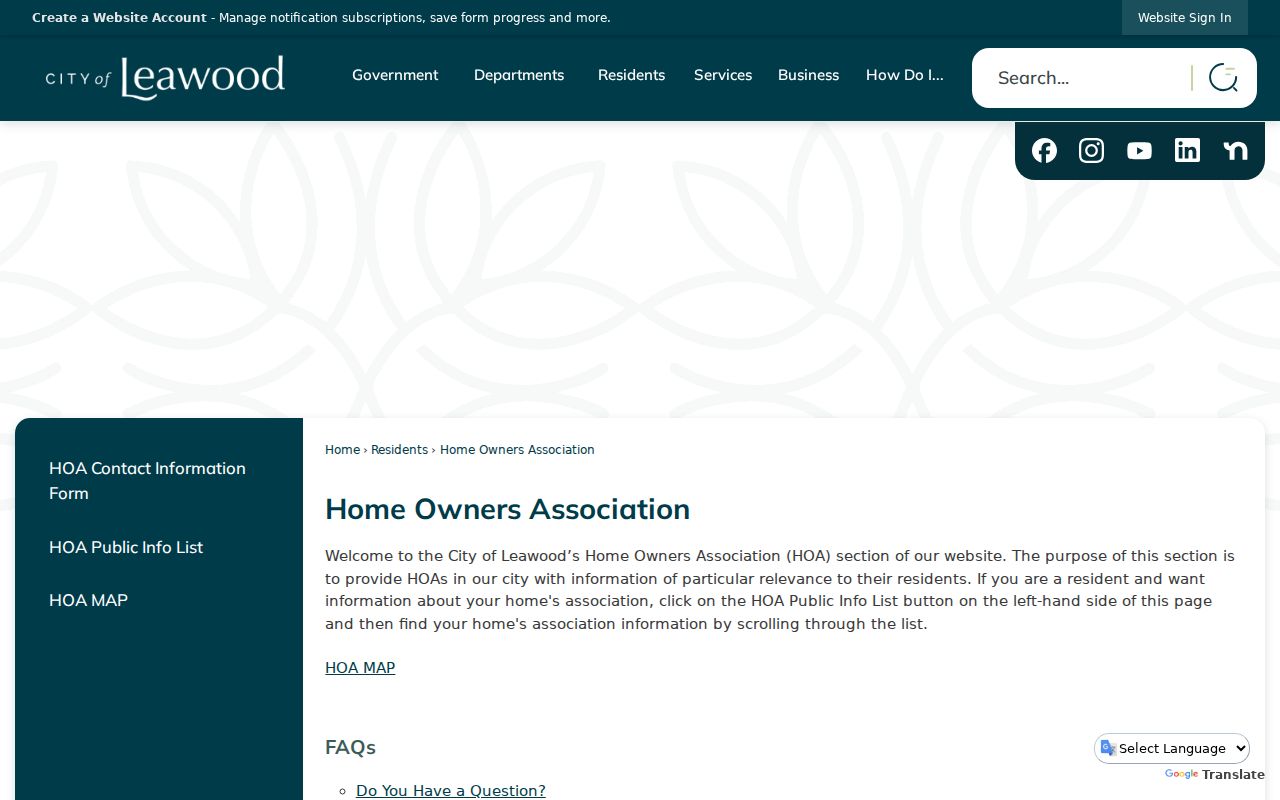
The image is a dated view of the city resource, not a resident roster. Contact an association for its current public information, and do not send private data through a general contact form.
Leawood Records Through Time
The record trail changes as Leawood shifts from rural land to a city. That change explains why one modern search cannot cover every era.
| Year | Local record clue |
|---|---|
| 1922 | Oscar G. Lee purchased the tract tied to early development. |
| 1937 | The Kroh development plat was recorded. |
| 1948 | Leawood incorporated with about 300 homes and a south edge near 103rd Street. |
| 1953 | The first City Hall began operating at 96th and Lee. |
| 2003 | Oxford School was moved to Ironwoods, changing the place tied to its name. |
Before incorporation, county deeds, plats, tax rolls, papers, cemetery records, and regional directories carry most of the evidence. After incorporation, city ordinances, minutes, legal notices, and archive files add a municipal layer. Preserve the date and exact place name from each source.
Leawood Oral History Clues
The Leawood Historical Commission oral histories come from interviews with long-time residents begun in the late 1990s. Bound volumes cover Oxford School, early Johnson County, Oscar Lee, Kroh development, and the city's founding. Full interviews may be arranged through the commission.
Oxford warns against quick matches. An old reference might mean the 1857 townsite, Oxford School, or the school after its later move. The Alexander Majors Home offers another boundary lesson: the house is on the Missouri side at 83rd and State Line, while the front yard reaches Leawood. Pair recollection with a dated map, photograph, deed, plat, or newspaper before making an address claim.
Trace Leawood Families by Directory
A sound city directory search follows a household across time while keeping each year's evidence separate. Census schedules can fill a wider interval, and the 1950 census is the latest full federal decennial schedule available under the 72-year rule as of the research date.
- Start with the best-known surname, initials, spouse, and approximate year. Ask which regional edition includes Leawood.
- Save the publisher, year, page, address, marks, and exact spelling. Check the abbreviation key.
- Move one available edition forward and backward. Note changes or a missing entry without guessing why.
- Use an address or criss-cross section when available. Compare the street wording with a plat or dated map.
- Pair the directory with a census, obituary, tax roll, newspaper, cemetery clue, or deed from the same period.
A person may vanish because of a move, death, publication gap, boundary change, spelling change, or a choice not to list. “No entry” proves only that the searched source did not return one. The Johnson County Archives adds tax rolls from 1862 through 2007 and non-certified marriage material from 1858 through July 1, 1911. Its research room is by appointment; requests may also go by phone, mail, or email.
Archive copies are 25 cents per page and prepaid. Staff research is limited to 30 minutes before a $25 hourly rate applies. The Archives does not perform detailed genealogy, broad surname lists, census searches, or transcription. Give staff a name, date span, record type, and known Leawood place.
Note: Cite every edition separately, because a city directory is a dated snapshot rather than a continuous resident record.
Confirm Leawood Directory Gaps
A missing edition is not evidence that a family left Leawood. No complete public, stand-alone Leawood directory run was verified. Ask the Johnson County Library Genealogy Desk to check its catalog, vertical files, microfilm, regional Kansas City volumes, and obituary cards. County Archives staff can route dated tax, marriage, probate, or naturalization leads.
Record the exact title, edition year, publisher, arrangement, call number, and page. If staff confirms that no edition is held, preserve that answer as a documented gap. Then move sideways to a dated tax roll, deed, census, obituary, newspaper, yearbook, oral history, or JoCoHistory item. This keeps the Leawood city directory trail honest and prevents a catalog miss from becoming a claim about a person.